
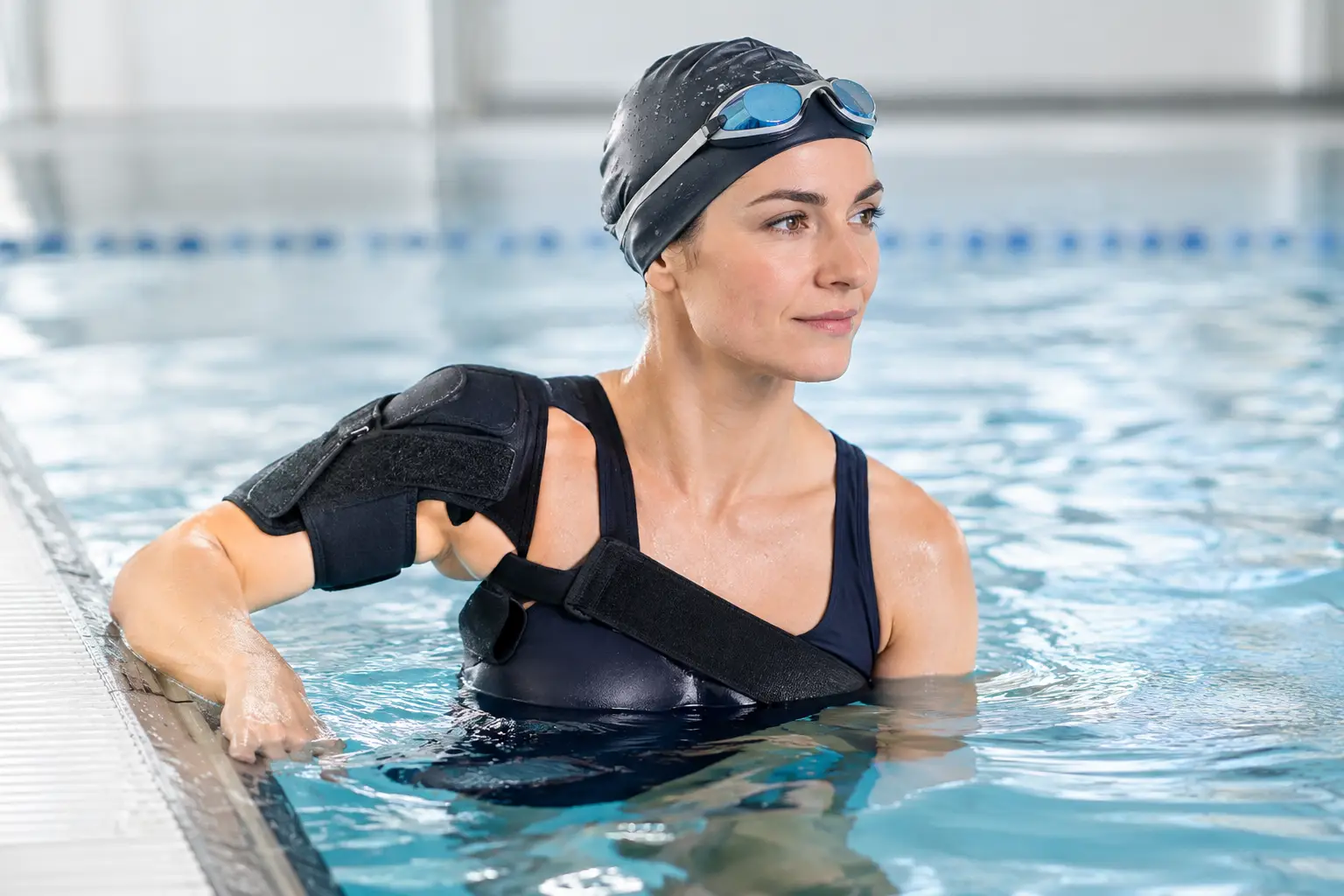
The pull through the water may feel like the final test of a repaired shoulder. But the decision to resume swimming after shoulder repair is not based on how much you miss the pool or even whether everyday movement feels normal. It depends on what was repaired, how securely it has healed, your restored strength and motion, and whether your shoulder can tolerate repeated overhead loading without compensation.
For swimmers, water polo players, triathletes, and active patients who use swimming for fitness, a thoughtful return plan protects the surgical repair while rebuilding confidence. The goal is not simply to get back in the pool. It is to return with a stroke that is efficient, controlled, and sustainable.
Why swimming places unique demands on a healing shoulder
Swimming is often considered low impact, and it is for the legs and spine. The shoulder is different. Each stroke requires repeated rotation, elevation, and force production through a large range of motion. Freestyle and butterfly, in particular, can place substantial stress on the rotator cuff, labrum, biceps tendon, and stabilizing muscles around the shoulder blade.
That repetition matters after surgery. A shoulder may be comfortable lifting a light object or performing a few exercises in physical therapy yet still be unprepared for hundreds of overhead stroke cycles. Fatigue can also change mechanics. When the shoulder blade muscles tire, swimmers may drop an elbow, cross the hand over the midline, or force motion from the front of the shoulder. These compensations can irritate healing tissue and create pain that was not present at the start of the workout.
The type of repair also changes the conversation. Recovery after a rotator cuff repair is different from recovery after a labral repair for instability, a SLAP repair, or surgery to address impingement and biceps pathology. A swimmer with a repaired shoulder dislocation needs adequate stability before returning to demanding overhead motion. A patient recovering from rotator cuff repair must allow the tendon to heal to bone before loading it aggressively. Your surgeon and physical therapist should set the timetable for your specific procedure, not a generic calendar from the internet.
When can you resume swimming after shoulder repair?
There is no single week when swimming becomes safe for everyone. Many patients begin pool-based activity only after their surgeon confirms that the incision has healed and the repair can be exposed to water. That is very different from swimming laps. Formal stroke progression generally comes later, after motion, strength, control, and surgical healing have advanced sufficiently.
For more extensive repairs, unrestricted swimming may take several months. Some athletes need longer, especially if they are returning to competition, butterfly, water polo, or open-water training. The right timeline is the one that respects biology and your sport-specific demands. Trying to accelerate it can turn a manageable recovery into a prolonged setback.
Before clearance for a gradual return, your care team typically looks for several practical milestones: minimal or no pain at rest and with daily activity, near-full range of motion appropriate for your shoulder, good rotator cuff and shoulder blade strength, and no sense of slipping, catching, or instability. Just as important, you should be able to perform prescribed rehabilitation exercises with sound form and without a pain flare that lasts into the next day.
Pain alone is not a perfect guide. Some repairs can be stressed before they become painful. Conversely, temporary muscle soreness during strengthening may be expected. That is why follow-up examinations and communication with your surgeon matter. They help distinguish normal recovery from a warning that the shoulder is receiving more load than it can manage.
A safer return-to-pool progression
Once you are cleared, the first sessions should feel almost too easy. Start with time in the water, kicking, and drills that keep the repaired shoulder protected as directed by your therapist. Depending on the procedure and your progress, this may include kicking with the arms at your sides or using a board only if it does not place the shoulder in a painful position. Do not assume a kickboard is harmless – holding it in front of you can still load the shoulder.
When stroke work begins, short intervals are generally safer than a continuous long swim. The focus should be technique, not yardage or pace. Freestyle is commonly reintroduced before more demanding strokes, but that sequence can vary. Butterfly produces high forces and is often one of the last strokes to return. Breaststroke can also be problematic for some patients because of the wide arm recovery and the demands placed on the front of the shoulder.
Increase only one variable at a time: total distance, session frequency, speed, resistance tools, or stroke variety. If you add distance, keep the pace easy. If you introduce faster work, reduce the overall volume. This measured approach makes it easier to identify what the shoulder tolerates and prevents a sudden jump in workload.
Avoid paddles, hand fins, resistance cords, and aggressive pull sets until your surgeon or therapist specifically approves them. These tools magnify force through the shoulder and can expose weakness or poor mechanics. They may have a place later in training, but they are not a shortcut to regaining swim fitness.
A useful rule is to monitor the shoulder during the session, later that evening, and the following morning. Mild muscular fatigue that resolves is different from sharp pain, deep joint pain, swelling, increasing stiffness, or soreness that carries forward into the next day. If symptoms persist or worsen, stop the progression and contact your care team for guidance.
Rebuild the strength behind a durable stroke
A strong return to swimming is built in rehabilitation, not just in the pool. The rotator cuff helps center the upper arm bone in the socket while the shoulder blade muscles provide the stable platform needed for overhead motion. Core and hip strength also matter because a balanced body position reduces the temptation to overload the shoulder during the pull.
Your physical therapy program may include controlled rotator cuff strengthening, shoulder blade stabilization, thoracic mobility, and gradual endurance work. These exercises can seem less exciting than getting back to laps, but they address the common reasons swimmers develop recurring shoulder symptoms. Quality matters more than the amount of weight used. A patient who can control the shoulder blade and upper arm through repeated movements is better prepared for the volume of a swim workout.
Technique deserves the same attention. A coach, therapist, or experienced swim professional may identify an elbow drop, crossover entry, limited body rotation, or breathing pattern that places unnecessary strain on the recovering side. For competitive swimmers, a return-to-sport assessment can be particularly valuable before resuming full practices, starts, turns, sprint sets, and dryland training.
Warning signs that should not be pushed through
Recovery includes occasional stiffness and muscle fatigue. It should not include symptoms that suggest loss of control, inflammation, or a new injury. Contact your surgeon if you develop sharp or escalating pain, a popping sensation followed by weakness, recurrent catching or locking, new swelling, a feeling that the shoulder is slipping out of place, numbness or tingling, fever, drainage, or redness around the incision.
Also pay attention to a quieter pattern: pain that appears earlier in every swim, loss of motion after activity, or a shoulder that feels noticeably weaker than the week before. These are reasons to pause rather than test your limits. Early evaluation can often adjust rehabilitation and training before a small problem becomes a major interruption.
Returning to practices and competition
Being cleared to swim easy laps is not the same as being ready for a full team practice or race. Competition adds fatigue, pace changes, crowded lanes, turns, starts, and the pressure to keep up. Youth swimmers may also face the challenge of returning during a school season, when training volume can rise quickly. Parents and coaches can help by supporting a staged return rather than expecting an immediate return to prior yardage.
A practical plan sets checkpoints: first tolerate easy technique sessions, then build frequency and distance, then add pace, then introduce all strokes and sport-specific demands. The order may shift based on the repair, the season, and the athlete’s goals. For some patients, protecting long-term shoulder health means skipping part of a season or modifying events. That is a difficult trade-off, but it is often preferable to risking the repair for a short-term milestone.
The best return is one that leaves you stronger and more confident after each stage. Keep follow-up appointments, complete the rehabilitation work between visits, and let your surgeon know how the shoulder responds to the pool. A patient-specific plan gives the repaired shoulder the time and preparation it needs to support the sport you want to keep doing.
Leave a Reply