
A torn ACL can change an athlete’s season in a single pivot, landing, or awkward change of direction. But the decision about ACL surgery is rarely as simple as an MRI result. The right plan depends on knee stability, associated injuries, sport demands, growth status in younger athletes, and the activities a patient wants to return to with confidence.
For many active patients, the goal is not simply to walk without pain. It is to cut, jump, ski, play soccer, compete on the court, or keep up with an active family without worrying that the knee will give way. A specialist evaluation helps turn that goal into a safe, individualized treatment plan.
When Is ACL Surgery Recommended?
The anterior cruciate ligament, or ACL, is one of the main stabilizing ligaments inside the knee. It helps control forward movement and rotation of the shin bone beneath the thigh bone. When it tears, some people can function well in straight-line activities, while others experience repeated instability during turning, pivoting, or landing.
ACL reconstruction is commonly considered when a patient has ongoing instability, wants to return to pivoting or contact sports, or has additional damage such as a meniscus tear. A knee that repeatedly buckles can place the meniscus and joint cartilage at further risk, particularly in athletes who continue to train or compete.
Surgery is not automatically necessary for every ACL tear. An older adult with low-demand activity goals, a patient with a partial tear and a stable knee, or someone willing to modify activities may do well with focused rehabilitation and bracing. The trade-off is that nonsurgical care may be less reliable for sports involving cutting, jumping, or rapid direction changes. The best choice follows a careful discussion of the knee, the patient’s goals, and the risks of each path.
The MRI Is One Part of the Picture
An MRI can confirm an ACL tear and identify injuries to the meniscus, cartilage, or other ligaments. It does not, by itself, determine whether surgery is needed. A physical examination, symptoms during activity, knee alignment, strength, age, skeletal maturity, and sport-specific demands all matter.
For parents of youth athletes, timing and technique require particular attention. Children and adolescents with open growth plates need an approach designed to protect normal growth while restoring knee stability. That is one reason evaluation by a sports medicine specialist experienced with both adult and pediatric athletes is valuable.
What Happens During ACL Reconstruction?
Most ACL surgery is a reconstruction, not a repair of the torn ligament itself. The damaged ACL is replaced with a graft that serves as a framework for new tissue to grow into over time. The procedure is generally performed arthroscopically through small incisions, using a camera and specialized instruments to work inside the knee.
The graft may come from the patient’s own tissue, called an autograft, or from donor tissue, called an allograft. Common autograft options include patellar tendon, quadriceps tendon, and hamstring tendon. Each has potential advantages and considerations.
A patellar tendon graft has a long history in high-demand athletes but may cause more discomfort at the front of the knee for some patients. A quadriceps tendon graft can provide substantial graft tissue and is used increasingly in athletes of different ages. Hamstring grafts may be appropriate in selected cases but can affect hamstring strength during recovery. Allografts can avoid a second surgical harvest site, but they may have a higher failure risk in younger, highly active athletes.
There is no single “best” graft for every person. Graft selection should reflect age, sport, prior surgery, anatomy, the condition of other knee structures, and the patient’s return-to-activity goals.
If a meniscus tear is found, it may be repaired or trimmed depending on the tear pattern, blood supply, and tissue quality. A meniscus repair can protect the knee over the long term, but it often means more restrictions early in recovery than an isolated ACL reconstruction. That short-term patience can be worthwhile when preserving healthy meniscus tissue is possible.
Preparing the Knee Before Surgery
A swollen, stiff knee is not an ideal knee for reconstruction. Before surgery, many patients benefit from prehabilitation – targeted exercises that reduce swelling, restore full knee extension, improve bending, and strengthen the quadriceps.
Entering surgery with better motion and muscle control can make the early recovery period more manageable. It also reduces the risk of postoperative stiffness. For an athlete eager to move quickly, this can feel like a delay. In reality, restoring motion before surgery is often one of the most efficient steps toward a better recovery.
Patients should also plan for practical needs: transportation after surgery, help at home for the first several days, time away from school or work, and a consistent physical therapy schedule. College athletes and families managing school calendars should discuss timing openly so rehabilitation can be structured around real-life obligations without compromising safety.
ACL Surgery Recovery Is Measured in Milestones
Recovery is not a countdown to a particular date. The graft and the knee need time, but progress should also be measured by objective milestones: range of motion, swelling control, walking mechanics, strength, balance, landing control, and sport-specific movement quality.
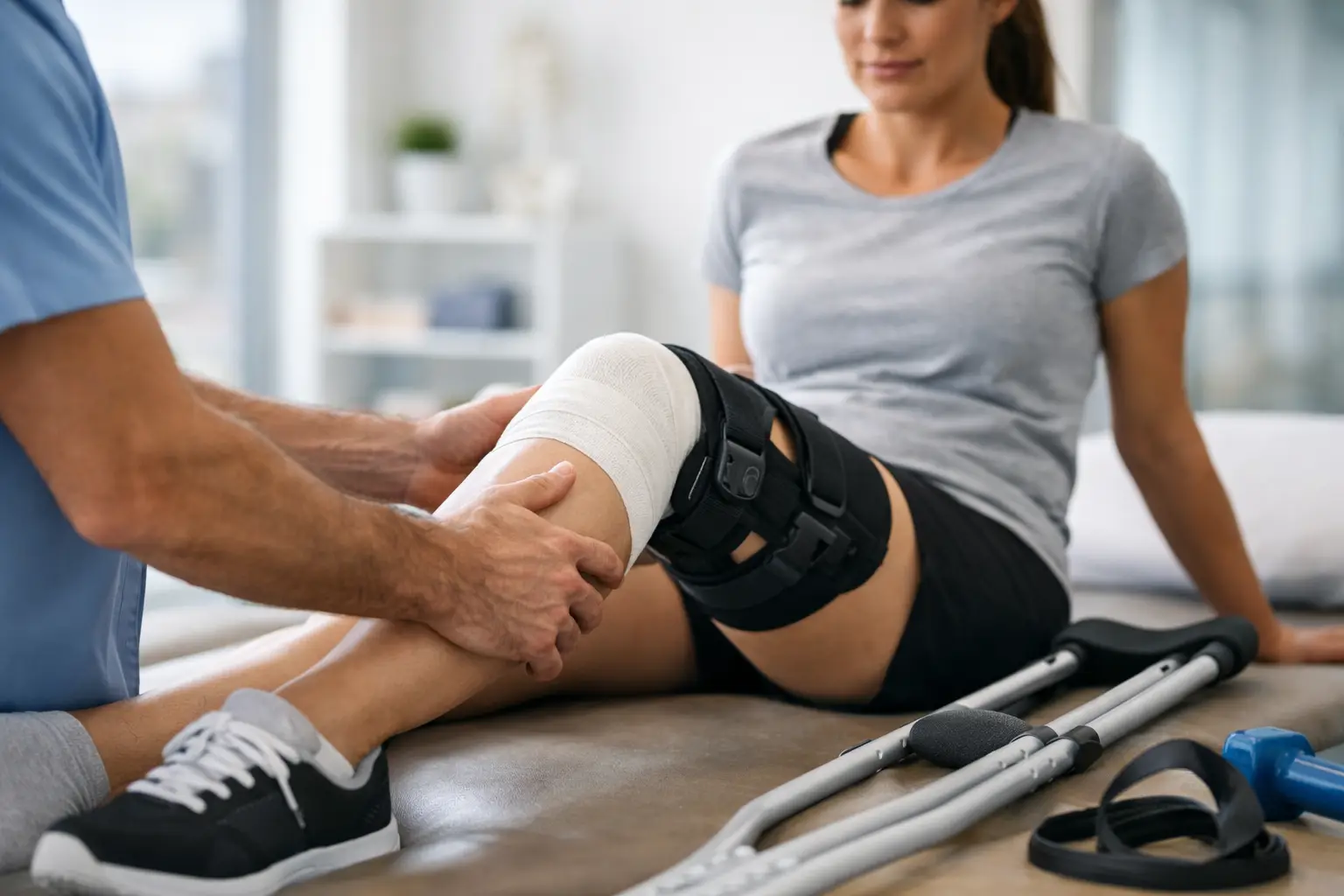
During the first few weeks, the focus is usually on protecting the reconstruction, controlling pain and swelling, regaining full extension, and reactivating the quadriceps. Crutches and a brace may be used initially, especially when meniscus repair or other procedures are performed at the same time.
As rehabilitation progresses, patients work on normal gait, deeper knee motion, leg strength, and single-leg control. Running is introduced only when the knee is ready, not simply because a certain number of weeks has passed. Persistent swelling, loss of motion, or poor control during basic exercises are signals to slow down and address the problem.
Later rehabilitation includes jumping, deceleration, cutting, and sport-specific drills. This phase matters because many ACL injuries occur during movement patterns that are not tested by jogging in a straight line. The athlete must rebuild confidence, but confidence should be supported by demonstrated strength and control rather than hope alone.
Why Return to Sport Takes Time
Many patients hear that return to sport may take nine months or longer. That timeline can be frustrating, especially for athletes facing a season, recruiting process, or senior year. Yet returning too early can increase the risk of graft injury or injury to the other ACL.
A safe return-to-sport decision should consider more than time since surgery. It should include near-symmetrical strength, hop and movement testing when appropriate, good landing mechanics, no significant swelling or instability, and psychological readiness. Some athletes need more time to trust the knee during full-speed play. That is common and should be addressed as part of rehabilitation, not dismissed.
Warning Signs That Deserve Attention
Some discomfort, bruising, and swelling are expected after surgery. However, patients should contact their surgical team promptly for increasing calf pain or swelling, shortness of breath, chest pain, fever, drainage from an incision, worsening redness, uncontrolled pain, or a sudden change in knee function. These symptoms may require urgent evaluation.
Follow-up visits are also an important part of recovery. They allow the surgeon to monitor healing, assess motion and stability, review progress with therapy, and adjust restrictions as needed. Rehabilitation works best as a coordinated effort among the patient, surgeon, physical therapist, family, and athletic support staff.
Building a Return That Lasts
The most successful ACL recovery is not defined only by a stable exam in the office. It is defined by a patient who can return to the activities that matter with appropriate strength, movement control, and a clear understanding of how to protect the knee going forward.
Dr. Louis Rizio’s approach to sports medicine care emphasizes that full journey: accurate diagnosis, thoughtful surgical planning when reconstruction is appropriate, and close attention to the rehabilitation milestones that support a safer return to play. Whether the patient is a young soccer player, a college athlete, or an active adult, the plan should match the person behind the injury.
A torn ACL is a significant setback, but it does not have to define an athlete’s future. Ask questions early, commit to the rehabilitation process, and treat each milestone as preparation for the next movement that matters.
Leave a Reply