
A painful shoulder that keeps you out of the gym, a swollen knee after a season of running, or persistent tennis elbow can make any treatment decision feel urgent. When patients ask about PRP versus cortisone injections, they usually want a clear answer: Which one will relieve pain and help me get back to my sport safely? The honest answer depends on the injured tissue, the severity of the condition, your timeline, and the larger treatment plan.
Neither injection is a substitute for an accurate diagnosis. Before choosing a treatment, a sports medicine specialist should identify whether pain is coming from inflammation, a tendon injury, arthritis, instability, a cartilage problem, or a structural tear that may require a different approach. The goal is not simply to make pain quieter for a few weeks. It is to protect function and create the best path back to the activities that matter to you.
PRP Versus Cortisone Injections: The Core Difference
Cortisone is a corticosteroid medication used to reduce inflammation. It can be particularly helpful when an inflamed joint or surrounding tissue is creating substantial pain, swelling, or stiffness. It does not repair a torn tendon, rebuild cartilage, or correct a mechanical problem such as a labral tear or instability. Its primary role is calming inflammation so that a patient can move more comfortably and participate in rehabilitation. In some instances, cortisone can damage tissue further or weaken it.
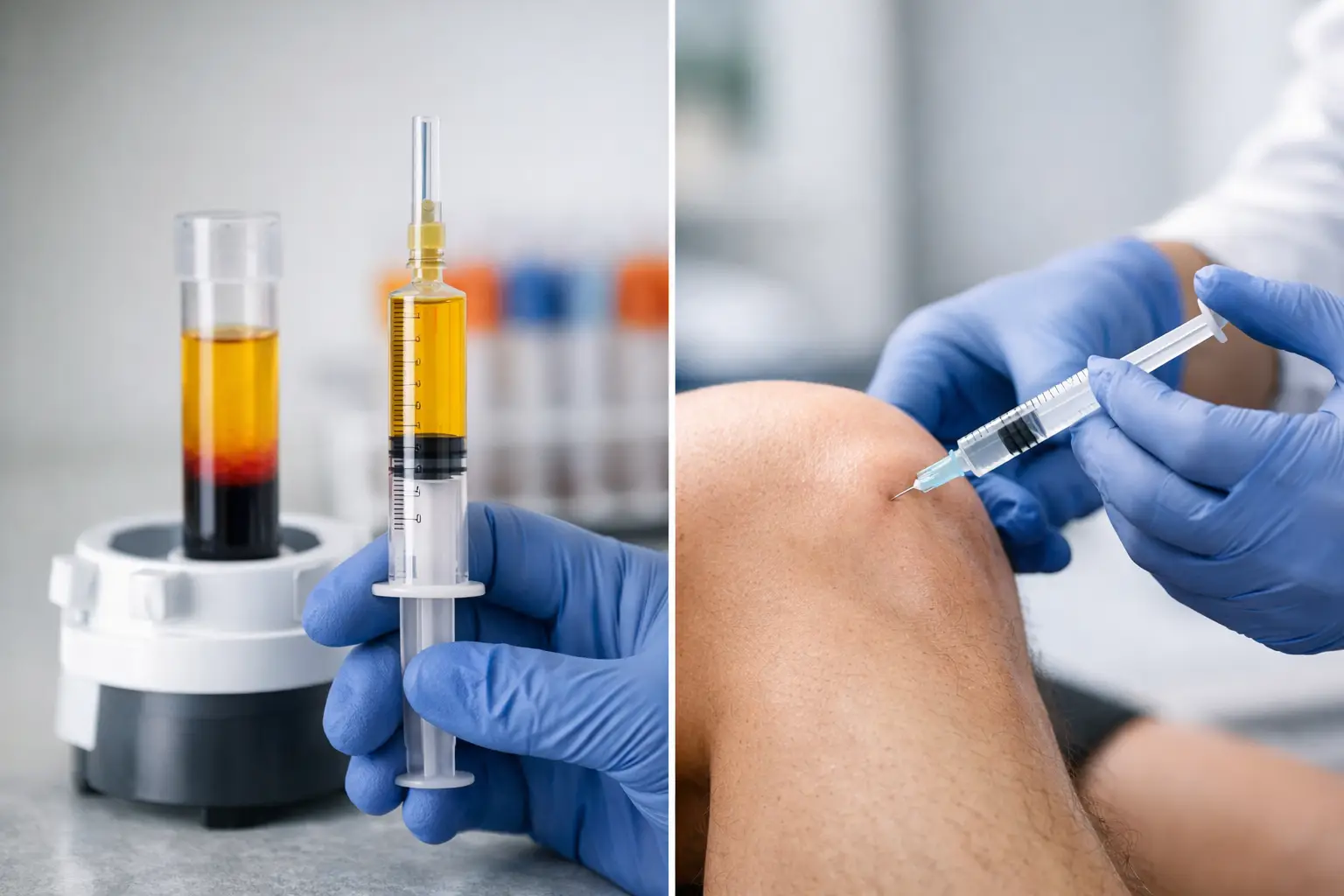
Platelet-rich plasma, or PRP, is prepared from a small sample of the patient’s own blood. The blood is processed to concentrate platelets, which contain signaling proteins involved in the body’s healing response. PRP is then injected into a carefully selected area, often with image guidance when appropriate. Rather than acting as a fast anti-inflammatory medication, PRP is intended to support the biologic healing environment in certain injured tissues.
That distinction affects timing and expectations. Cortisone may provide relief within days, although results vary. PRP commonly causes soreness for several days and may take weeks to show benefit. For an athlete hoping to play this weekend, neither option should be viewed as an automatic clearance decision. Returning too soon can turn a manageable injury into a more significant one.
When Cortisone May Be the Better Choice
A cortisone injection can be a reasonable option when inflammation is the primary barrier to movement and rehabilitation. For example, a patient with painful shoulder bursitis, an arthritic knee flare, or significant joint inflammation may need enough symptom relief to sleep, restore motion, and begin physical therapy effectively.
Its advantage is speed. If pain is preventing normal daily activity or blocking progress in a supervised rehabilitation program, reducing inflammation can help reset the situation. For some active adults, that can mean getting through a demanding work period, a family event, or the early phase of recovery without persistent pain controlling every decision.
However, cortisone must be used thoughtfully. Repeated steroid injections into the same area can be problematic, particularly around tendons. In some situations, steroids may weaken tendon tissue or mask pain that should be guiding activity modification. Patients with diabetes should also know that cortisone can temporarily raise blood sugar levels. The number, location, and timing of injections should be individualized rather than scheduled automatically.
Cortisone is usually not the right answer for every athlete with a tendon problem. If a tendon is substantially torn, if the joint is unstable, or if pain is signaling a condition that needs surgical consideration, suppressing symptoms alone may delay appropriate care.
When PRP May Be Worth Considering
PRP is most often considered for selected tendon, ligament, joint, and muscle-related conditions when the diagnosis and injury pattern suggest that a biologic treatment may be useful. It may be discussed for certain cases of chronic tennis elbow, patellar tendon pain, Achilles tendon conditions, knee osteoarthritis, or partial soft-tissue injuries. It may also be part of a broader nonoperative plan for patients who have not improved with rest, activity modification, and structured therapy.
The appeal of PRP is understandable. It uses material from your own blood and aims to support healing rather than simply reduce inflammation. For athletes and active patients, that approach can fit well when the priority is durable function, not just short-term symptom control.
Still, PRP is not a universal fix. Research findings differ by body part, diagnosis, PRP preparation, injection technique, and patient population. One patient’s excellent response does not guarantee the same result for another patient with a similar MRI report. A complete rotator cuff tear, a displaced meniscus tear, recurrent shoulder dislocation, or a full ACL tear will not be repaired by PRP alone.
PRP also requires patience and follow-through. Depending on the condition, a patient may need a period of modified activity, a progressive physical therapy program, and carefully planned return-to-sport testing. The injection is one step in treatment, not the entire treatment.
The Diagnosis Matters More Than the Trend
PRP has gained attention among professional athletes, while cortisone has been used in orthopaedics for decades. That can make the choice seem like a contest between an older treatment and a newer one. In practice, the more useful question is: What is causing the pain, and what needs to change for this body part to tolerate sport again?
Consider two patients with shoulder pain. One may have inflamed bursitis and impingement symptoms that improve with targeted rehabilitation and, in the right setting, a cortisone injection. Another may have a traumatic labral tear with instability after a collision. Even if both report pain when lifting an arm, their treatment plans should be very different.
The same applies to knee pain. A runner with early osteoarthritis, a soccer player with a meniscus tear, and a high school athlete recovering from an ACL injury may all ask about injections. Their age, sport, examination findings, imaging, stability, swelling pattern, and goals all influence whether PRP, cortisone, physical therapy, surgery, or simple activity modification makes sense.
What the Treatment Process Should Look Like
A well-planned injection starts with a focused evaluation, not a menu of options. Your specialist should review how the injury occurred, where symptoms are located, what movements trigger pain, prior treatments, medical history, and the demands of your sport or job. X-rays, MRI findings, or ultrasound may add useful information, but they are interpreted alongside the physical examination.
If an injection is appropriate, the exact target matters. Injecting medication into a joint is different from treating a tendon sheath, bursa, or tissue injury. Image guidance may be used when it improves precision, particularly in deeper joints or around sensitive structures. Precision is part of both safety and effectiveness.
After cortisone, patients are often advised to reduce strenuous activity briefly before gradually resuming therapy and sport-specific training. After PRP, the post-injection plan can be more restrictive at first because the area may be sore and because the treatment is intended to work alongside a healing response. Anti-inflammatory medication may be limited around PRP treatment in some cases, but the guidance should be individualized by the treating physician.
For parents of youth athletes, the same principle applies with added caution. A young athlete’s desire to stay on the field should never outweigh a careful diagnosis and age-appropriate recovery plan. The safest return is one based on restored strength, motion, control, and confidence, not merely a temporary reduction in pain.
Questions to Ask Before Choosing an Injection
Before deciding between PRP and cortisone, ask what structure is injured, what the injection is expected to accomplish, how long improvement may take, and what rehabilitation will follow. It is also reasonable to ask about potential risks, whether image guidance is recommended, whether the treatment is covered by insurance, and what symptoms would indicate that a different treatment is needed.
Most importantly, ask how the choice affects your return-to-sport plan. A good recommendation should account for the calendar, but it should not sacrifice the health of a shoulder, knee, elbow, or ankle for one game or one tournament. For some patients, rapid inflammation control is the right next step. For others, a PRP-based strategy may better fit a chronic tissue problem and a longer recovery horizon.
At Dr. Louis Rizio’s practice, treatment decisions are made with the full picture in mind: the diagnosis, the sport, the patient’s age, and the function needed to return safely. The right injection is not necessarily the newest option or the fastest one. It is the option that supports a sound recovery plan and gives you the strongest opportunity to keep doing what you love.
Leave a Reply