
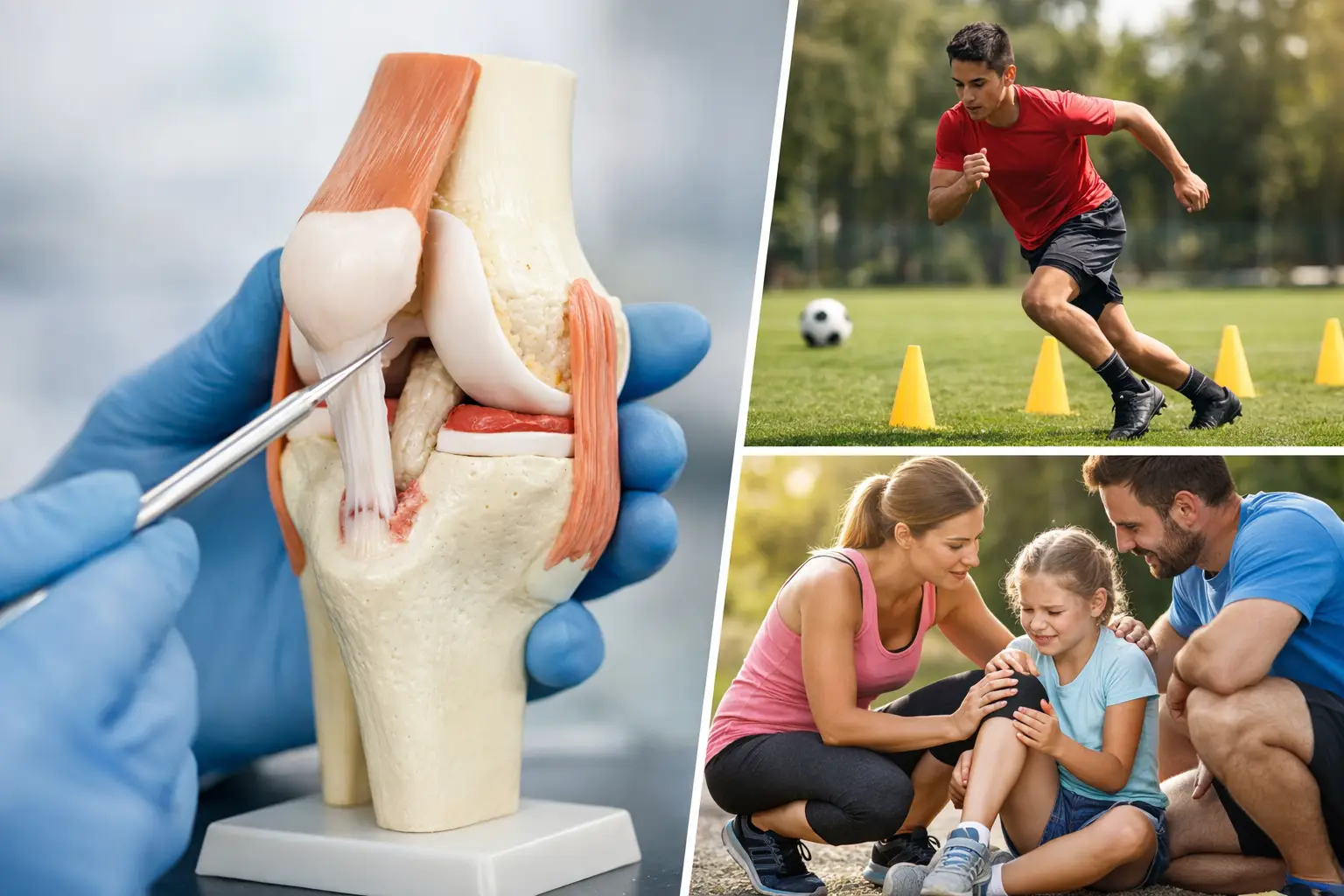
An ACL tear can change an athlete’s season in one play. Once surgery becomes the recommended path, the conversation quickly turns to graft choice. This ACL graft guide explains the materials used to rebuild the ligament, the trade-offs behind each option, and the questions that help patients and families make an informed decision.
The anterior cruciate ligament, or ACL, helps control rotation and forward movement of the knee. When it is torn, some people can walk and perform daily activities without major instability. Cutting, pivoting, landing, and sudden changes of direction are different. For athletes returning to sports such as soccer, basketball, football, lacrosse, skiing, or gymnastics, recurrent giving-way episodes can place the meniscus and cartilage at further risk.
ACL reconstruction does not stitch the torn ligament back together in most cases. It replaces it with a graft that is secured in precisely placed bone tunnels. Over time, the body incorporates the graft and remodels it into a functioning ligament. Choosing the right graft is an individualized clinical decision, not a one-size-fits-all answer.
What an ACL Graft Does
A graft serves as the foundation for the new ACL. The surgeon positions it to restore knee stability while respecting the anatomy of the individual patient. Early on, the fixation devices and the graft itself provide mechanical support. During recovery, the body gradually brings blood supply and living cells into the tissue, a process often called ligamentization.
That biologic healing is one reason rehabilitation and return-to-sport timing matter so much. A knee may feel better well before the graft, muscles, balance, and movement patterns are ready for unrestricted pivoting sport. Successful ACL care is not only about a technically sound operation. It also depends on structured physical therapy, strength restoration, movement training, and a careful return-to-sport assessment.
ACL Graft Guide: Comparing Your Options
The two broad categories are autografts and allografts. An autograft uses the patient’s own tissue, usually taken from around the knee. An allograft uses donor tissue that has been screened and processed for transplantation. Each has potential advantages, limitations, and appropriate uses.
Patellar Tendon Autograft
A bone-patellar tendon-bone graft uses the central portion of the patellar tendon, along with small bone plugs from the kneecap and shinbone. Because bone is secured to bone in the tunnels, this option has a long track record and can offer strong fixation.
For younger athletes involved in high-demand pivoting sports, a patellar tendon graft may be a strong consideration. Research and clinical experience have supported its durability in many active populations. The trade-off is that some patients experience pain in the front of the knee, kneeling discomfort, or irritation around the graft harvest site. That may carry particular weight for wrestlers, catchers, people whose work requires kneeling, or patients who already have significant kneecap pain.
Quadriceps Tendon Autograft
A quadriceps tendon graft is taken from the tendon above the kneecap. It has become an increasingly common option for primary ACL reconstruction, particularly because it can provide a substantial graft while avoiding some of the kneeling discomfort associated with patellar tendon harvest.
This graft can be a useful choice for adolescent and adult athletes, as well as for certain revision cases. As with every autograft, there is a harvest site to heal. Early rehabilitation may need to account for quadriceps weakness, and restoring full strength is essential before return to running, jumping, and sport.
Hamstring Tendon Autograft
Hamstring grafts are typically created using one or more tendons from the inside of the thigh. They have been used successfully for many years and can result in less pain at the front of the knee than a patellar tendon graft.
The key consideration is hamstring strength and graft size. For some athletes, particularly those who rely on explosive acceleration or have generalized looseness in their joints, a surgeon may weigh these factors carefully. Modern techniques can produce excellent results, but the best choice depends on the patient’s anatomy, age, sport, and risk profile rather than on a single rule.
Allograft Tissue
Allograft tissue avoids taking a tendon from the patient’s own knee. This can mean less harvest-site discomfort and may shorten the surgical portion of the procedure. Allografts can also be valuable in selected revision operations or complex reconstructions where multiple tissues are needed.
For young, highly active athletes returning to cutting and pivoting sports, however, allograft tissue has been associated with a higher risk of graft failure than autograft in many studies. Processing methods, patient age, activity level, and the specific graft all matter. An allograft may still be reasonable for an older recreational athlete or in other carefully selected situations, but it deserves a direct discussion about expected activity and re-injury risk.
Age, Sport, and Growth Plates Matter
Graft selection is especially nuanced for pediatric and adolescent patients. Children and teens may still have open growth plates, which requires techniques designed to protect normal growth while restoring knee stability. The athlete’s skeletal maturity, not simply the number of birthdays, helps guide the surgical plan.
Parents are often understandably focused on getting a child back for the next season. The safer goal is to restore a stable knee and reduce the risk of a second injury over the long term. Young athletes have a meaningful risk of tearing the reconstructed ACL or injuring the ACL in the opposite knee, particularly if they return before strength, control, and confidence have been rebuilt.
For college athletes and competitive high school players, the decision may also involve recruiting calendars, scholarship concerns, school demands, and team schedules. Those pressures are real, but they should not set the biologic timeline. A return date should be based on recovery milestones, not just the date of surgery.
Questions That Lead to a Better Decision
A productive graft discussion should connect the medical details to the patient’s actual life. Ask whether your age and sport place you in a higher-risk group for graft failure. Discuss whether you have pain at the front of the knee, prior tendon injuries, joint laxity, or job demands that could affect graft selection.
It is also reasonable to ask how the selected graft may influence early rehabilitation, when running may begin, and what benchmarks are required before return to play. A surgeon should explain why a particular graft is recommended for you, along with reasonable alternatives. MRI findings are useful, but the complete plan comes from the examination, activity goals, knee anatomy, and any associated injuries to the meniscus, cartilage, or other ligaments.
Graft Choice Is Only One Part of the Outcome
The best graft cannot compensate for an incomplete rehabilitation program or a rushed return to competition. Recovery commonly extends over many months, and athletes should expect phases that include regaining motion, reducing swelling, restoring strength, building single-leg control, progressing to running, and finally returning to sport-specific drills.
Objective testing can help guide this process. Strength comparisons between legs, hop testing, landing mechanics, movement quality, and psychological readiness all provide useful information. Passing time alone is not the same as being prepared to play.
At a specialist sports medicine evaluation, the goal is to identify the graft and treatment approach that fit the person in front of you – whether that is a youth soccer player, a college basketball guard, or an active adult who wants confidence on the ski slope. Dr. Louis Rizio’s approach centers on that individualized decision-making and on following recovery beyond the operating room.
A thoughtful graft choice gives reconstruction a strong starting point. The lasting result comes from pairing that choice with patient, consistent rehabilitation and a return to activity earned through demonstrated readiness.
Leave a Reply