
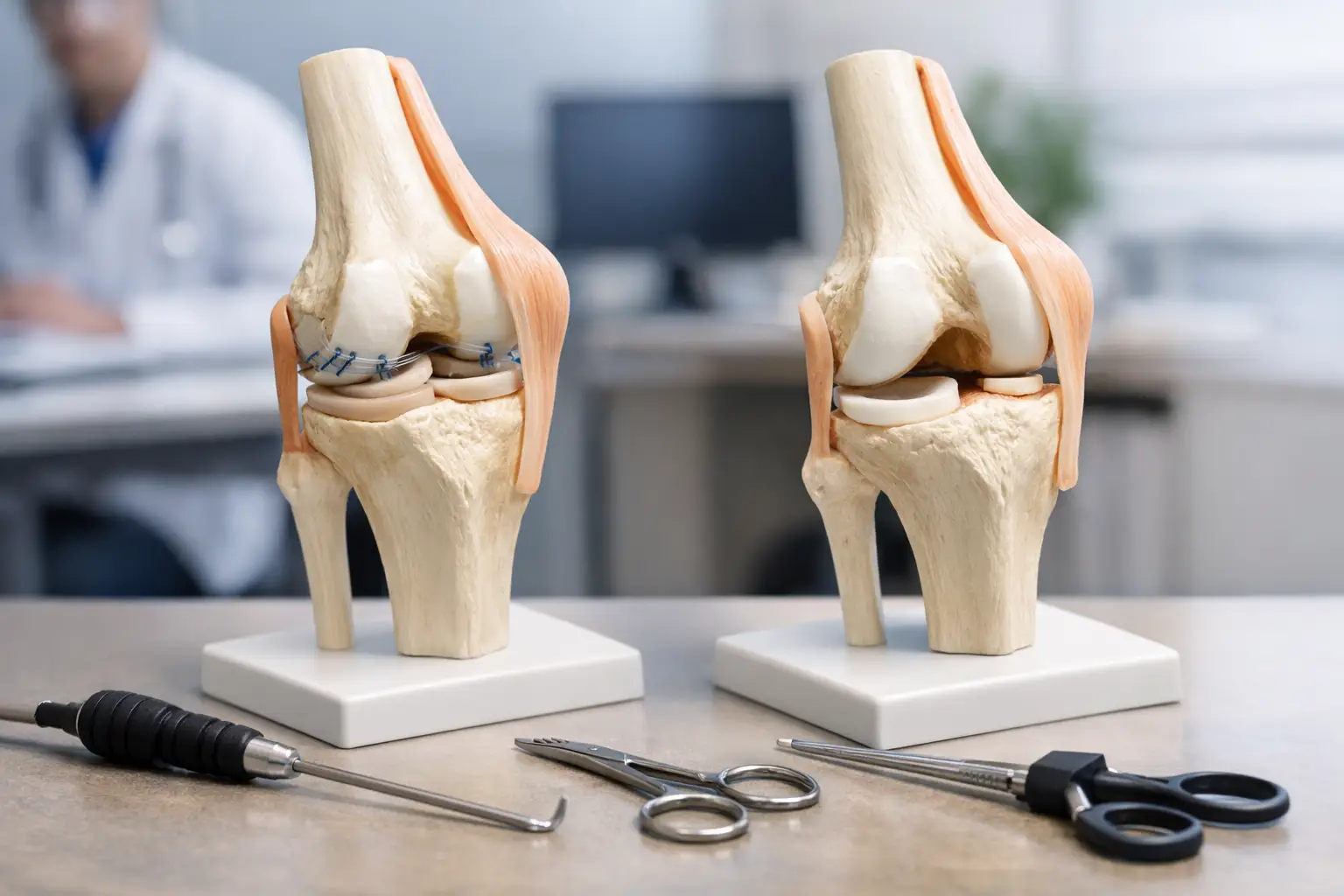
A meniscus tear can turn a routine pivot, squat, or landing into a knee that catches, swells, or will not fully straighten. When an MRI confirms a tear, the question often becomes meniscus repair meniscectomy: should the torn tissue be stitched back together, or should the unstable damaged portion be removed? The right answer depends on more than the scan. It depends on the tear itself, the condition of the knee, and what a safe return to sport or active daily life requires.
Why the Meniscus Matters
Each knee has two menisci, crescent-shaped pads of cartilage that sit between the thighbone and shinbone. They help distribute force across the joint, improve stability, and protect the smooth cartilage covering the ends of the bones. For athletes, they are especially important during cutting, decelerating, jumping, and deep bending.
A meniscus can tear during a single twisting injury, often along with an ACL injury, or gradually over time as tissue becomes less resilient. Symptoms vary. Some patients have sharp pain along the joint line; others notice recurrent swelling after activity, a feeling of giving way, catching, or mechanical locking. A small tear may be manageable without surgery, while a displaced tear that blocks motion may need more urgent attention.
The goal is not simply to make an MRI look better. It is to preserve knee function, relieve meaningful symptoms, protect the joint when possible, and help the patient return safely to the activities that matter to them.
Meniscus Repair vs. Meniscectomy
Both procedures are commonly performed arthroscopically through small incisions using a camera and specialized instruments. The difference is what happens to the torn tissue.
Meniscus repair preserves the tissue
During a meniscus repair, sutures or specialized fixation devices are used to stabilize the tear so it can heal. Preserving meniscal tissue is generally preferred when the tear has a reasonable chance of healing because the meniscus continues to provide cushioning and load distribution for the knee.
Not every tear can be repaired. Healing potential is greatest in the outer portion of the meniscus, where there is a better blood supply. A vertical tear near the periphery, a root tear, or certain displaced bucket-handle tears may be repairable depending on tissue quality and chronicity. Repairs are also frequently considered in younger athletes and in patients having ACL reconstruction, since the environment created during ACL surgery may support healing.
The trade-off is recovery. A repaired meniscus needs time to heal before it is exposed to full loads and twisting forces. The rehabilitation plan may include crutches, a brace, temporary limits on knee bending, and a more gradual return to running and sport. Repair also carries a possibility that the tissue will not heal fully and that another procedure may eventually be necessary.
Partial meniscectomy removes unstable tissue
A partial meniscectomy removes only the torn, unstable portion of the meniscus while preserving as much healthy tissue as possible. It may be appropriate when a tear occurs in an area with limited healing blood supply, when the tissue is frayed or degenerative, or when the pattern is not suitable for fixation.
For the right tear, trimming the unstable fragment can reduce catching and pain more predictably than attempting a repair that is unlikely to heal. Recovery is often faster than after a repair, with many patients progressing quickly in physical therapy and returning to routine daily activity within weeks.
The important long-term consideration is that less meniscal tissue remains to protect the joint. Removing a portion of the meniscus does not guarantee arthritis, but loss of meniscal tissue can increase contact stress in the knee over time. This is why surgeons aim to preserve the meniscus whenever it is both technically possible and clinically sensible.
What Determines the Best Procedure?
A surgeon does not make the repair-versus-meniscectomy decision based on age alone or on one line in an MRI report. The arthroscopic view can also provide essential information about the exact tear pattern, tissue quality, and cartilage condition.
The location of the tear is central. Tears in the vascular outer zone have better healing potential than tears deep in the inner zone. Pattern matters as well. A clean, vertical tear may be repaired, while a complex tear with multiple frayed segments may not hold sutures reliably.
Timing can matter. Acute traumatic tears in a young athlete may behave differently from a longstanding tear that has been repeatedly loaded. However, an older active adult should not automatically be directed toward meniscectomy, and a younger patient should not receive a repair that has little chance of healing. The best choice is individualized.
Associated injuries also affect planning. A meniscus tear combined with ACL instability requires careful treatment because returning to cutting sports with an unstable knee can place the repair at risk. Alignment, cartilage wear, prior surgery, activity demands, and the patient’s willingness to follow postoperative restrictions all deserve a place in the discussion.
Recovery Timelines Are Different
Patients understandably ask, “When can I play again?” A useful answer requires knowing which procedure was performed and what sport or activity they plan to resume.
After partial meniscectomy, many patients can bear weight as tolerated shortly after surgery. Swelling control, restoring full motion, and rebuilding quadriceps strength remain important. Low-impact exercise often resumes sooner than pivoting sports, and a return to competition should still be based on strength, movement quality, symptoms, and the demands of the sport rather than the calendar alone.
After meniscus repair, protection is part of the treatment. Weight-bearing and range-of-motion restrictions vary with the repair location and pattern. Physical therapy progresses from restoring motion and controlling swelling to strengthening, balance work, running, and sport-specific drills. Return to pivoting or contact sports commonly takes several months, often four to six months or longer for a complex repair or when combined with ACL reconstruction.
A faster recovery is not automatically a better recovery if it comes at the cost of removing tissue that could have been preserved. Conversely, preserving tissue is not the right choice if the tear is unlikely to heal and would prolong symptoms or delay a reliable return to activity. This is the balance behind a thoughtful surgical recommendation.
Questions Worth Asking at Your Consultation
An MRI report is a starting point, not a complete treatment plan. Patients and parents should feel comfortable asking whether the tear appears repairable, what factors influence healing, and how much meniscal tissue can be preserved. It is also reasonable to ask how a planned procedure will affect school, work, travel, physical therapy, and the timeline for a specific sport season.
For a competitive athlete, the conversation should include the demands of the position, season timing, previous knee injuries, and whether the knee is stable enough for a safe return. For an active adult, it may center on stairs, work responsibilities, recreational sports, and protecting the knee for the years ahead. Clear expectations before surgery help prevent frustration during rehabilitation.
At Dr. Louis Rizio’s practice, surgical decisions are made with attention to the patient’s examination, imaging, activity goals, and full recovery plan, not simply the presence of a tear on a scan.
When Surgery May Not Be the First Step
Not every meniscus tear needs immediate surgery. If symptoms are mild, the knee is not locking, and the tear is stable, a period of activity modification, anti-inflammatory measures when appropriate, and structured physical therapy may improve pain and function. This is particularly common with some degenerative tears in adults.
Surgery becomes more compelling when pain and swelling persist despite appropriate nonsurgical treatment, when mechanical symptoms interfere with motion, or when a traumatic tear threatens knee function in an athlete. The decision should be driven by symptoms and function, not MRI findings alone.
A torn meniscus is disruptive, but it does not have to define the rest of an athlete’s season or an active adult’s routine. The most useful next step is a specialist evaluation that identifies the tear accurately, weighs preservation against reliability, and builds a recovery plan around returning to the movements and activities you value.
Leave a Reply