
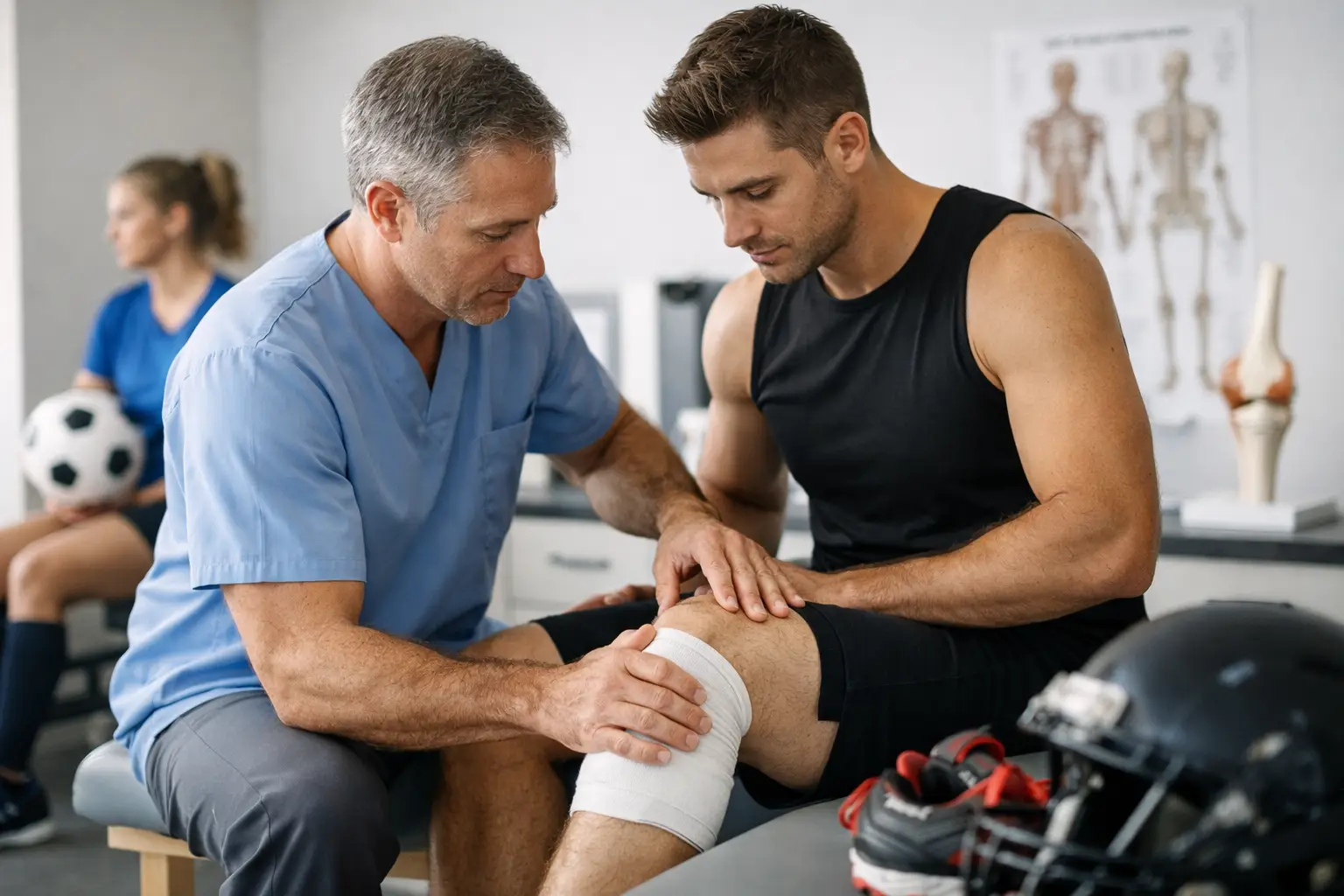
A painful pop in the knee during a pivot, a shoulder that slips out during a tackle, or an elbow that will not settle down after months of throwing can quickly change an athlete’s season. But sports injuries are not limited to varsity players or weekend leagues. They also affect active adults, growing children, runners, gym-goers, and anyone whose work or daily routine depends on comfortable movement. So, what does a sports medicine specialist treat? The answer includes both sudden injuries and the overuse conditions that can gradually interfere with sport, work, and everyday life.
For patients with a significant injury, the goal is not simply to reduce pain. It is to identify what has been damaged, protect healing tissue, restore strength and motion, and make a safe plan for returning to the activities that matter most.
What Does a Sports Medicine Specialist Treat?
Sports medicine is focused on injuries and conditions involving the bones, joints, muscles, tendons, ligaments, and cartilage. While the name suggests a narrow focus on organized athletics, treatment is appropriate for people of all activity levels. A parent who injured a knee while skiing, a high school pitcher with shoulder pain, and an adult whose hip hurts after increasing mileage may all benefit from a sports-focused evaluation.
The exact scope of care depends on the specialist’s training. A nonoperative sports medicine physician may concentrate on diagnosis, rehabilitation, activity modification, and injections. An orthopaedic sports medicine specialist can also evaluate whether surgery is needed and perform procedures such as ligament reconstruction, arthroscopy, or tendon repair. In either setting, the best treatment is individualized. Many injuries improve without surgery, while others require timely repair to restore stability or protect long-term joint function.
Acute Injuries That Need Prompt Evaluation
Acute sports injuries happen during a fall, collision, awkward landing, sudden change of direction, or forceful movement. Some are straightforward, such as a mild ankle sprain. Others can involve structural damage that is easy to underestimate in the first few days after an injury.
Common acute conditions include fractures, joint dislocations, muscle strains, ligament sprains, tendon tears, and cartilage injuries. A specialist also evaluates swelling, loss of motion, numbness, weakness, and the athlete’s ability to bear weight or use the affected limb. X-rays may help identify fractures or alignment problems, while an MRI may be used when there is concern for a torn ligament, meniscus, labrum, rotator cuff, or other soft-tissue structure.
A knee that swells quickly after a pivoting injury, for example, can indicate an ACL tear, a meniscus tear, or both. A shoulder that dislocates during contact sports may injure the labrum and leave the joint vulnerable to repeat instability. Early assessment helps avoid the common mistake of returning to activity because pain has improved, even though the joint remains unstable or unprotected.
Knee Injuries, Including ACL and Meniscus Tears
Knee injuries are among the most frequent reasons athletes and active adults seek sports medicine care. The knee relies on ligaments, menisci, cartilage, and muscles working together during cutting, jumping, squatting, and landing. When one structure is injured, the entire movement pattern can change.
An ACL tear often occurs during a noncontact pivot, awkward landing, or sudden deceleration. Patients may describe hearing or feeling a pop, followed by swelling and instability. Treatment depends on age, activity goals, associated injuries, knee stability, and the sports or work demands ahead. Some patients can function well with rehabilitation and activity modification. For patients who want to return to pivoting or contact sports, or whose knee repeatedly gives way, ACL reconstruction may be the more reliable path to restoring stability.
Meniscus tears can occur with trauma or develop over time. A torn meniscus may cause joint-line pain, catching, locking, swelling, or difficulty fully straightening the knee. Not every meniscus tear needs surgery. The tear pattern, its location, symptoms, age, and activity level all matter. When surgery is appropriate, preserving and repairing the meniscus whenever possible can be especially valuable because the meniscus helps cushion and protect the joint.
Sports medicine specialists also treat MCL and LCL injuries, patellar instability, cartilage injuries, tendon problems around the kneecap, and persistent pain after a prior knee injury or surgery.
Shoulder Pain, Instability, and Rotator Cuff Injuries
The shoulder is built for motion, which also makes it vulnerable to instability and overuse. Throwing athletes, swimmers, tennis players, weightlifters, and contact-sport athletes commonly develop shoulder symptoms, but shoulder injuries also affect adults after falls, lifting incidents, and repetitive work.
A sports medicine specialist evaluates common causes of shoulder pain, including labral tears, rotator cuff tears, impingement, bursitis, biceps tendon injuries, AC joint sprains, and shoulder dislocations. The right diagnosis matters because several shoulder problems can feel similar at first. Pain at night may suggest a rotator cuff issue, while a sense that the shoulder is slipping or deadening during a throw may point toward instability or a labral injury.
For a first-time dislocation, rehabilitation may be appropriate in some circumstances. However, younger contact athletes and patients with recurrent dislocations often face a higher risk of continued instability. Surgical stabilization may be recommended when the shoulder repeatedly slips out, when imaging shows meaningful labral or bone injury, or when the patient cannot safely return to required activity.
Rotator cuff treatment also varies. Partial tears and tendinitis may respond to physical therapy, adjusted training, anti-inflammatory strategies, and selected regenerative orthopaedic treatments such as PRP when clinically appropriate. A full-thickness tear, significant weakness, or loss of function may call for surgical repair. The decision should reflect the patient’s symptoms, imaging, functional needs, and recovery goals, not an MRI report alone.
Overuse Injuries and Training-Related Pain
Not all sports injuries begin with one memorable moment. Overuse injuries develop when the demand placed on a tissue exceeds its ability to recover. A rapid increase in training, poor mechanics, inadequate rest, growth spurts in young athletes, or a return to activity after time away can all contribute.
These conditions may include tennis or golfer’s elbow, Achilles tendinitis, patellar tendinitis, shin splints, stress reactions or stress fractures, plantar fasciitis, hip pain, and throwing-related elbow or shoulder pain. Young athletes deserve particular attention because growth plates can be vulnerable. Persistent heel pain, elbow pain, or knee pain in a child is not always something to “play through.”
The care plan often includes a careful review of training volume, sport-specific mechanics, footwear or equipment when relevant, strength deficits, flexibility, recovery habits, and physical therapy needs. Rest can be necessary, but it is rarely the whole plan. The aim is to address why the injury developed and create a graded return that does not restart the same cycle.
When Surgery, PRP, or Rehabilitation May Be Considered
Sports medicine care spans nonoperative and surgical options. Physical therapy is often central to recovery, whether a patient is managing an injury without surgery or rebuilding after a procedure. It helps restore range of motion, strength, balance, coordination, and confidence in sport-specific movement.
PRP and other orthobiologic treatments may be considered for select tendon, ligament, or joint conditions. These treatments are not a universal replacement for surgery or rehabilitation, and results can vary by diagnosis. A responsible recommendation begins with an accurate diagnosis and a discussion of the evidence, expected benefit, cost considerations, and alternatives.
Surgery may be recommended for injuries such as complete ligament tears with instability, repairable meniscus tears, recurrent shoulder dislocations, significant labral tears, certain rotator cuff tears, and fractures or tendon ruptures. When surgery is needed, the recovery timeline should be explained clearly. Returning to sport is a process, not a date on the calendar. Healing, strength testing, movement quality, and the demands of the sport all influence readiness.
When to See a Sports Medicine Specialist
Consider scheduling an evaluation when pain lasts beyond a few days, limits normal activity, returns every time you resume training, or is accompanied by swelling, instability, locking, weakness, or loss of motion. It is also reasonable to seek a second opinion after an MRI finding or when previous treatment has not produced the expected progress.
Urgent evaluation is appropriate for a visibly deformed joint, inability to bear weight after an injury, severe swelling, a limb that feels cold or numb, or symptoms that suggest a fracture or dislocation. Continuing to compete through these warning signs can turn a manageable injury into a longer recovery.
The right specialist will look beyond the scan and the immediate symptom. For athletes and active families, the most useful care plan is one that respects the injury, the season, school or work obligations, and the patient’s long-term ability to keep moving with confidence. Whether the next goal is returning to a competitive field, lifting a child without pain, or simply taking a run without hesitation, a clear diagnosis is the place to start.
Leave a Reply