
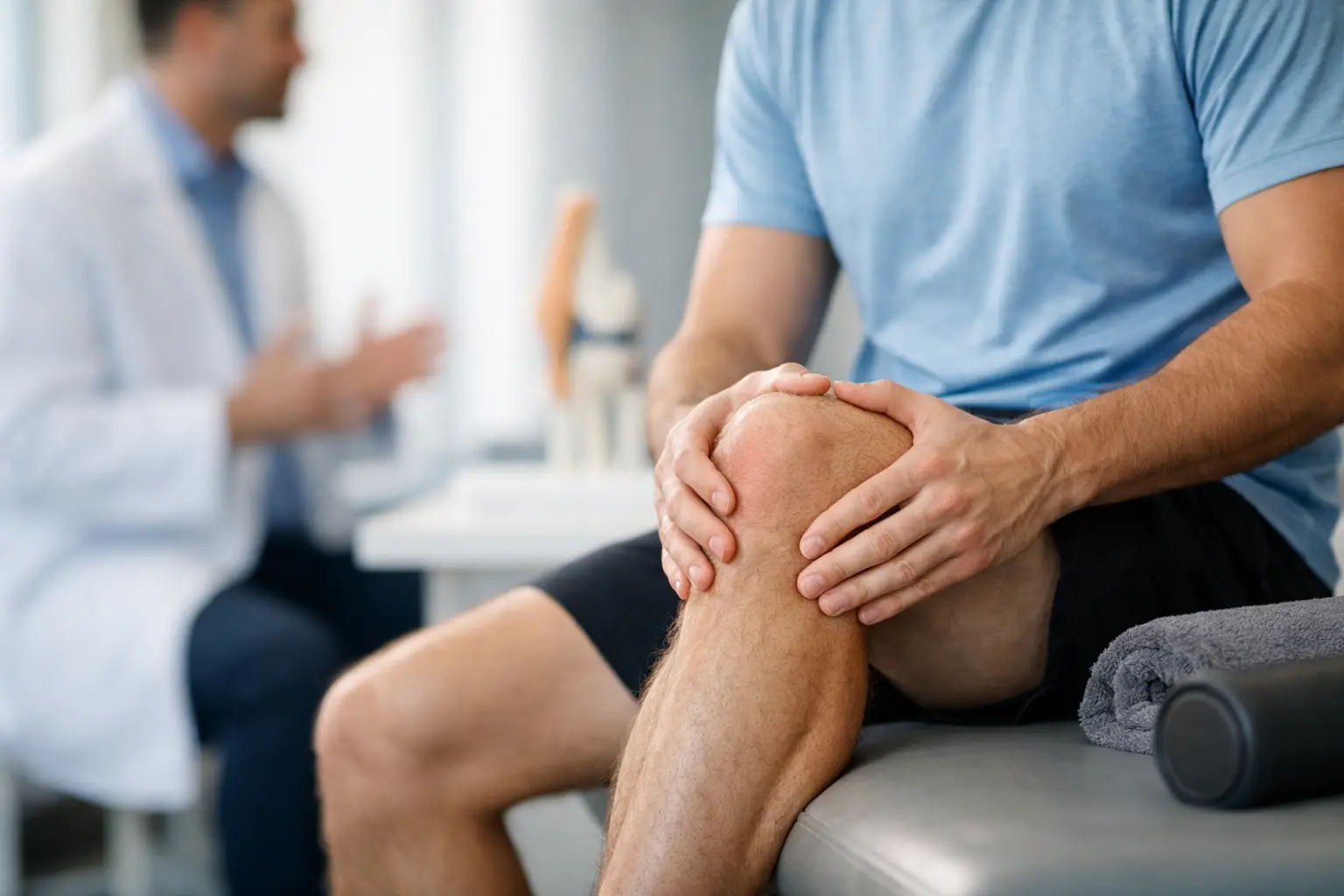
A meniscus tear on an MRI can feel like an immediate threat to a season, a job, or the simple routines that keep you active. But an MRI finding is not, by itself, a verdict that surgery is necessary. For many patients, meniscus tear treatment without surgery can reduce pain, restore useful knee function, and allow a safe return to the activities they value.
The right plan depends on more than the word “tear.” A sports medicine evaluation considers how the injury happened, the tear’s location and pattern, your symptoms, knee stability, age, activity goals, and whether the knee is catching or locking. The goal is not merely to avoid an operation. It is to choose the treatment path that gives the knee its best chance to function reliably now and in the future.
What the Meniscus Does and Why Tears Feel Different
Each knee has two menisci: C-shaped pads of cartilage that help distribute load between the thighbone and shinbone. They improve shock absorption, contribute to stability, and protect the smooth joint cartilage during running, cutting, jumping, squatting, and everyday walking.
A meniscus can tear during a sudden twist, pivot, or deep squat, particularly in sports such as soccer, basketball, football, skiing, and tennis. In adults, tears can also develop gradually as the tissue changes over time. That distinction matters. A traumatic tear in a young athlete and a degenerative tear in an active middle-aged adult may look similar on imaging but can behave very differently.
Symptoms vary widely. Some people have sharp pain along the joint line, swelling after activity, or pain with squatting and rotation. Others mainly notice stiffness or a loss of confidence when changing direction. A knee that truly locks and cannot fully straighten deserves prompt evaluation because a displaced piece of meniscus may be blocking motion.
When Meniscus Tear Treatment Without Surgery Is Reasonable
Nonoperative care is often a sensible first step when symptoms are manageable, the knee has full or near-full motion, and there is no mechanical block to movement. It is particularly common for small, stable tears and for degenerative tears associated with early wear changes in the knee.
The meniscus has a limited blood supply. Its outer portion, sometimes called the red zone, has better healing potential than the inner portion. Still, healing on an MRI is not the only measure of success. A person may have a visible tear yet be pain-free, strong, and fully capable of participating in their chosen activities. Treatment should be guided by function and symptoms, not imaging alone.
For athletes, the decision also depends on the demands of the sport. A runner with mild discomfort that settles with rehabilitation may progress differently from a lacrosse player whose knee repeatedly catches during cutting. Parents of young athletes should know that pediatric and adolescent tears deserve careful specialist assessment. Younger patients may have repairable tears, and preserving meniscal tissue can be especially important for long-term knee health.
A Focused Nonoperative Plan
A well-designed nonsurgical plan is active, not passive. Simply waiting for the knee to improve without addressing strength, swelling, movement quality, and sport demands can leave an athlete vulnerable to recurring symptoms.
Control Pain and Swelling Early
In the first days after an injury, reducing irritation helps the knee move more normally. Relative rest means avoiding the specific movements that cause sharp pain or swelling, rather than stopping all activity. Ice after activity, compression, elevation, and short-term use of anti-inflammatory medication may help some patients, provided it is appropriate for their medical history.
Low-impact conditioning can often maintain fitness while the knee settles. Depending on symptoms, this may include cycling, pool exercise, or upper-body training. The appropriate choices should not increase swelling or cause catching in the knee.
Restore Motion and Build Knee Control
Physical therapy is usually the centerpiece of conservative care. Early treatment often focuses on restoring full knee extension, improving comfortable bending, and reducing the limp that can overload other joints. As symptoms improve, rehabilitation progresses to the quadriceps, hamstrings, gluteal muscles, calves, and core.
Strength alone is not enough for an athlete returning to a cutting or jumping sport. Therapy should also address balance, landing mechanics, single-leg control, deceleration, and gradual changes of direction. For active adults, the same principles apply to stairs, uneven ground, golf, fitness classes, and work demands.
A useful rehabilitation program has measurable goals. Swelling should be controlled, range of motion should be close to normal, strength should be comparable from side to side, and sport-specific movements should be tolerated before full return. The timeline varies. Some patients improve substantially within several weeks, while others need a longer, carefully progressed course.
Modify Activity Without Losing Your Routine
Temporary modification is not failure. It is a way to keep training while giving an irritated knee an opportunity to calm down. A basketball player may work on shooting, upper-body strength, and cycling before resuming full scrimmage. A runner may use walk-run intervals or cross-training before adding mileage and hills.
Pain during activity is only part of the picture. Swelling later that day or the next morning is often a better sign that the knee was asked to do too much. A gradual progression, rather than a sudden return to tournament play or a demanding weekend workout, is more likely to hold up.
Injections and Orthobiologic Options
In selected cases, an injection may be discussed as part of a broader treatment plan. Corticosteroid injections can sometimes reduce inflammation and pain associated with arthritis or synovitis, but they do not repair a torn meniscus. Platelet-rich plasma, or PRP, is another option that may be considered for certain patients with persistent symptoms or early degenerative knee changes.
These treatments require realistic expectations. Results can vary based on the tear, the health of the joint, and the rehabilitation program that follows. An injection should not be used to mask repeated locking, major instability, or symptoms that warrant a different level of care.
Signs That Surgery May Be the Better Choice
Avoiding surgery is not always the safest route. A displaced tear can cause repeated catching, locking, or an inability to fully straighten the knee. A traumatic tear associated with an ACL injury, significant instability, or persistent swelling may also need more urgent attention. If a structured period of rehabilitation does not improve pain and function enough for normal life or sport, it is reasonable to revisit the diagnosis and treatment options.
Surgery is not one-size-fits-all, either. When an operation is appropriate, preserving and repairing the meniscus is generally preferable to removing tissue whenever the tear pattern and blood supply make repair feasible. Some tears cannot be repaired reliably and may require partial meniscectomy, where only unstable damaged tissue is trimmed. The rehabilitation and return-to-sport timeline differ significantly between these procedures.
A second opinion can be valuable when an MRI report sounds alarming, symptoms do not match the imaging, or surgery has been recommended without a clear discussion of alternatives. The key question is not simply, “Can I avoid surgery?” It is, “What choice best protects my knee and supports my goals?”
Returning to Sport With Confidence
A pain-free walk is not the same as readiness for competition. Before returning to pivoting sports, an athlete should be able to fully bend and straighten the knee, complete strengthening work without joint swelling, and perform sport-specific drills without pain, catching, or hesitation. Return should be progressive: individual drills first, then controlled practice, then full practice, and finally competition.
For a recreational athlete, the standard should still be meaningful. You should be able to manage the movements your activity requires, whether that means getting low for a tennis ball, hiking downhill, carrying equipment, or playing with your children, without the knee reacting afterward.
The most reassuring path forward is an accurate diagnosis paired with a plan that respects both the injury and the life you want to return to. With close attention to symptoms, purposeful rehabilitation, and timely reassessment when progress stalls, many patients can move forward confidently without rushing into surgery.
Leave a Reply