
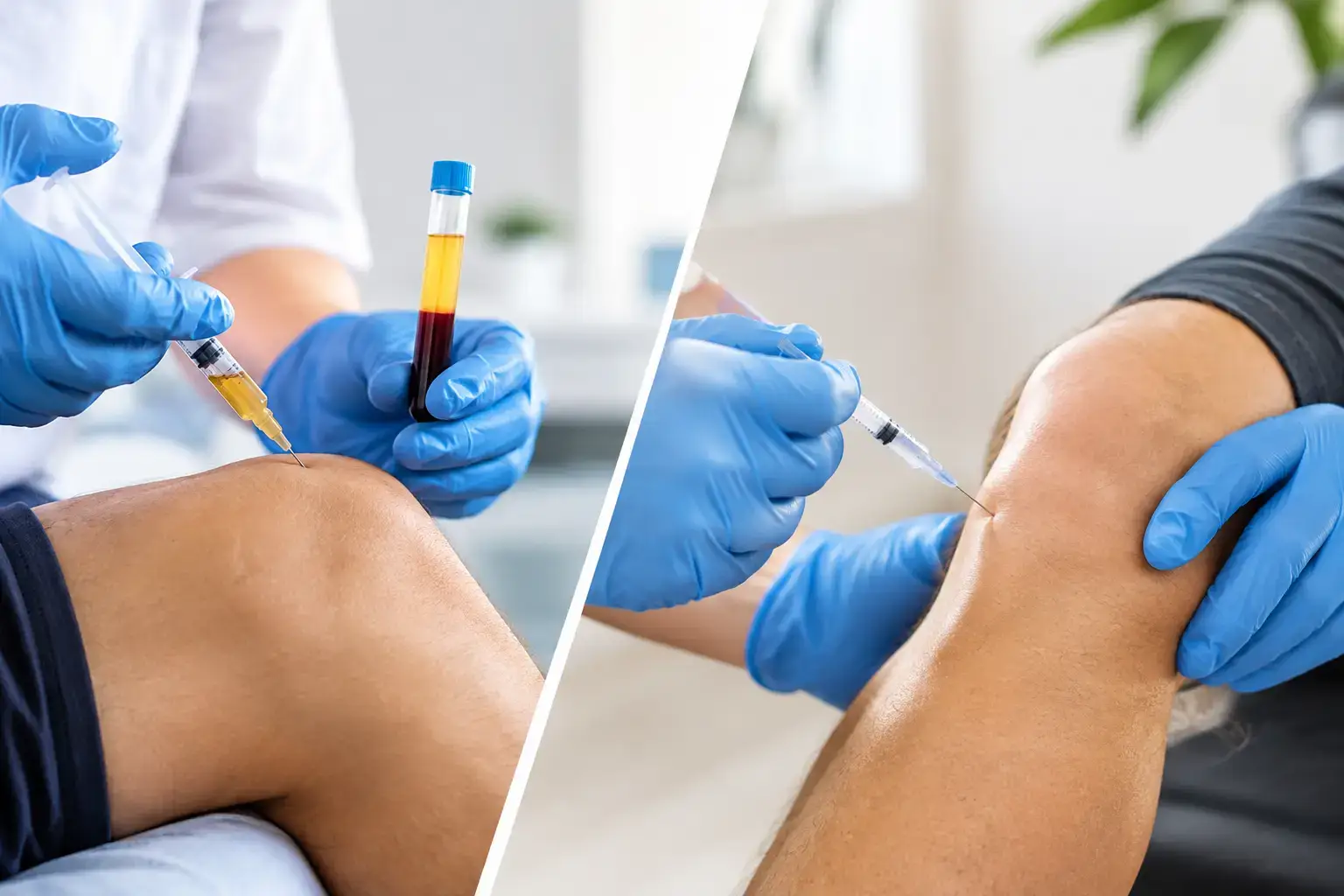
A painful tendon, unstable-feeling joint, or injury that has stalled despite physical therapy can make injection treatment sound like a quick answer. Yet PRP versus prolotherapy is not a simple choice between two interchangeable procedures. The right recommendation depends on the precise tissue involved, the severity and duration of symptoms, imaging findings, prior care, and what you need to return to – whether that is a varsity season, weekend tennis, or comfortable daily movement.
Both treatments are often discussed under the broad label of regenerative or orthobiologic care. Neither should replace a careful sports medicine evaluation. In many cases, a well-designed rehabilitation program, activity modification, or surgical repair is more appropriate. When an injection is considered, the goal should be to support a specific treatment plan, not to chase relief without understanding the injury.
PRP versus prolotherapy: the core difference
Platelet-rich plasma, or PRP, is prepared from a small sample of your own blood. The blood is processed to concentrate platelets, which contain signaling proteins involved in the body’s healing response. The PRP is then injected into a carefully selected injured area, commonly with ultrasound guidance when appropriate.
Prolotherapy most often involves an injection of a solution containing dextrose, a form of sugar, and sometimes an anesthetic. The solution is intended to create a local inflammatory response that may stimulate the body’s repair process. It has historically been used for certain chronic ligament, tendon, and joint-related pain conditions.
The practical distinction is straightforward: PRP uses components from your own blood, while standard prolotherapy uses an irritant solution. The clinical distinction is more nuanced. PRP has been more extensively studied for some tendon disorders and certain osteoarthritis-related symptoms, although results vary significantly by condition, preparation method, injection technique, and patient population. Evidence for prolotherapy is more limited and mixed, but it may be considered in selected cases.
Neither treatment can reliably repair a complete rotator cuff tear, a displaced meniscus tear, a torn ACL, or substantial shoulder instability. In those situations, delaying appropriate surgical consultation can prolong symptoms and make return to sport more difficult.
What PRP may be used for
PRP is commonly considered for chronic tendon conditions that have not improved with an appropriate period of nonsurgical care. Examples can include tennis elbow, patellar tendinopathy, Achilles tendinopathy, and some forms of gluteal tendon pain. It may also be discussed for mild to moderate knee osteoarthritis in the right patient.
For an athlete, the key question is not simply whether PRP may reduce pain. It is whether the diagnosis supports using it and whether it can be paired with a progressive loading program that restores strength, movement control, and sport-specific capacity. A tendon that feels better but has not regained load tolerance remains vulnerable when sprinting, jumping, throwing, or changing direction resumes.
PRP is not one uniform product. Platelet concentration, the presence or absence of white blood cells, the volume injected, and the use of imaging guidance can differ among practices. That variability helps explain why patients may hear conflicting accounts of PRP outcomes. It also reinforces why treatment should be directed by a physician who understands the anatomy, injury pattern, and functional demands of the athlete.
Where prolotherapy may fit
Prolotherapy is sometimes considered for chronic pain thought to involve ligament laxity, tendon attachment irritation, or selected joint conditions. It may be an option when a patient has persistent symptoms despite a structured rehabilitation program and the examination suggests that an injection could complement continued strengthening and movement retraining.
However, the diagnosis matters especially when a joint feels loose or unstable. A shoulder that slips during throwing, a knee that gives way after a pivot, or an ankle that repeatedly rolls may reflect a structural injury that needs a more complete workup. Labral tears, ACL injuries, significant ligament tears, and recurrent dislocations are not problems to treat based on symptoms alone.
For young athletes and their parents, this distinction is particularly important. Growth-related conditions, overuse injuries, cartilage problems, and instability can produce similar complaints. An injection should not become a shortcut around an accurate diagnosis or a return-to-play plan.
Evidence matters, but so does the individual injury
Patients often ask which procedure is “better.” That question is reasonable, but it does not have one answer. Research is generally stronger for PRP in some chronic tendon conditions and knee osteoarthritis than it is for prolotherapy. Even so, PRP does not work equally well for every tendon, joint, or stage of disease.
A recent injury may need protection, bracing, rehabilitation, or surgery rather than a biologic injection. A long-standing tendon problem may require a reassessment of training errors, mechanics, recovery habits, and strength deficits before another procedure is considered. Advanced arthritis may respond differently than early arthritis. A partial tear may have a very different treatment path from a complete tear.
This is why an MRI report alone is not enough to determine treatment. Imaging must be interpreted alongside your symptoms, physical examination, activity goals, and response to prior care. Some MRI findings are incidental. Others are the reason an athlete cannot safely return to play.
What the appointment and recovery process should look like
Before recommending PRP or prolotherapy, a sports medicine specialist should identify the pain generator and rule out conditions that need a different approach. This may include a detailed history, examination, review of X-rays or MRI images, and discussion of previous physical therapy, injections, medications, and sport demands.
During the procedure, the injection site is cleaned and the targeted tissue is addressed with appropriate technique. Ultrasound guidance can be valuable for many tendon, muscle, and joint injections because it helps confirm needle placement and avoid nearby structures. PRP requires a blood draw and processing before injection; prolotherapy generally does not.
Soreness after either injection is common. With PRP, discomfort can be more noticeable for several days because the treatment is designed to provoke a healing response. Your physician will provide individualized guidance about activity, pain control, and medications. Anti-inflammatory medicines are sometimes limited around PRP treatment, but instructions vary based on the condition and your medical history.
Most patients should expect a staged recovery rather than an immediate return to sport. Early care may focus on relative rest and range of motion. Rehabilitation then progresses through strength, endurance, balance, and sport-specific drills. For a runner, that may mean rebuilding calf and hip strength before mileage. For a baseball player, it may mean restoring shoulder strength and throwing mechanics before a throwing program begins.
Safety, cost, and realistic expectations
PRP and prolotherapy are generally performed as outpatient procedures, but no injection is risk-free. Potential complications include pain flare, bruising, bleeding, infection, nerve or blood vessel injury, and failure to improve. Certain medical conditions, medications, active infections, and bleeding concerns may affect whether a procedure is appropriate.
Insurance coverage can also be a factor. Many insurance plans do not cover PRP, and coverage for prolotherapy is often limited. Patients deserve a clear discussion of expected costs, alternatives, and the uncertainty that can accompany biologic treatments before scheduling a procedure.
Be cautious about promises that an injection will regenerate cartilage, eliminate the need for surgery, or guarantee a faster return to competition. A responsible recommendation should include the possibility that symptoms may improve only partially or not at all. It should also explain what the next step would be if the treatment does not provide the desired result.
Choosing the right path for your return to activity
The best choice is often not PRP or prolotherapy in isolation. It is a complete plan that matches the biology of the injury with the demands of your life and sport. For one patient, that plan may include PRP and progressive physical therapy. For another, it may be continued rehabilitation without an injection. For an athlete with a repairable structural injury, timely surgery and focused postoperative rehabilitation may offer the clearest route back to stable, confident performance.
If pain has kept you from training, work, or the activities that matter to you, seek an evaluation that looks beyond the injection itself. A precise diagnosis and a realistic return-to-activity plan can help you make a treatment decision with confidence – and protect the progress you have worked hard to regain.
Leave a Reply