
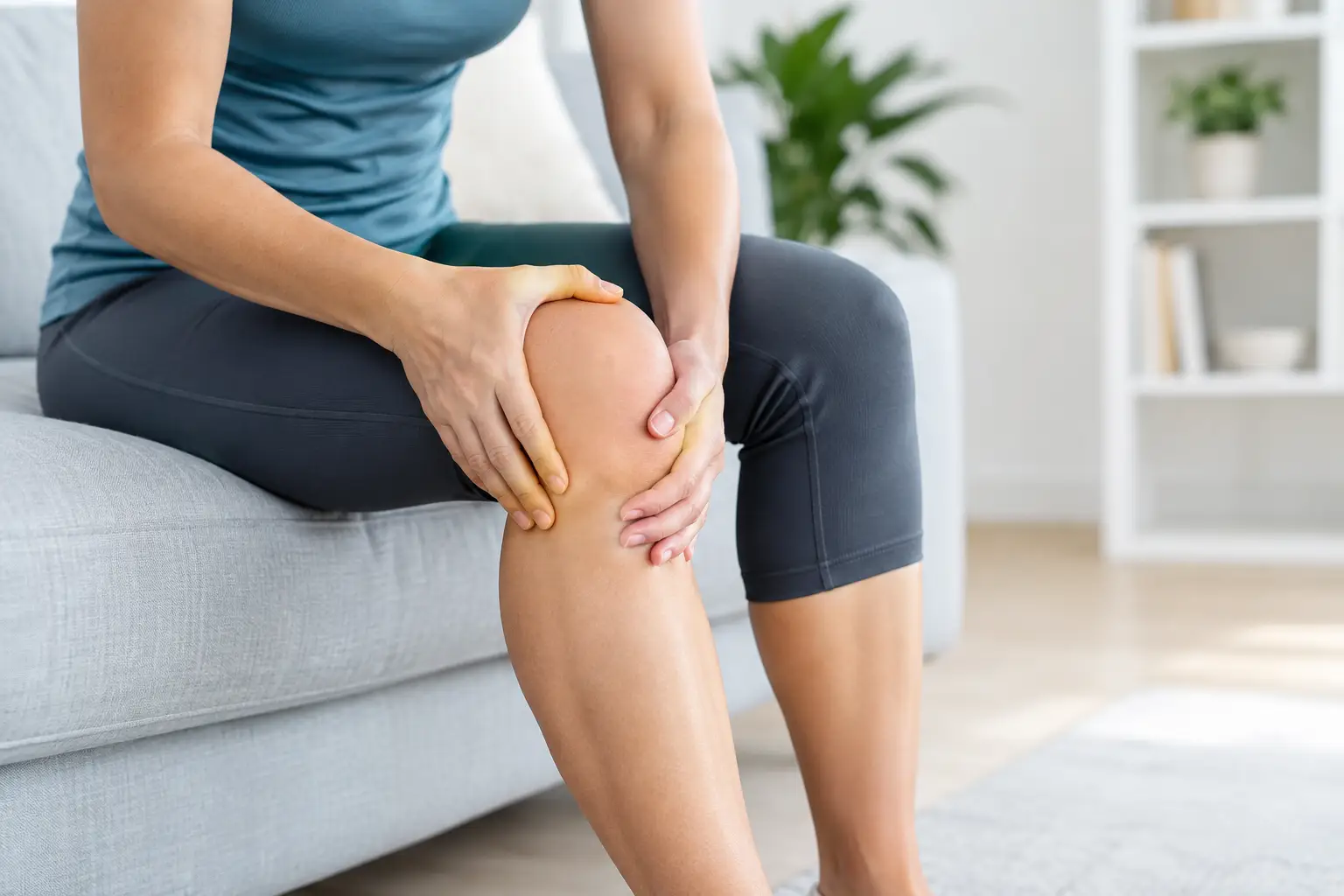
A knee that suddenly catches and will not fully bend or straighten can stop an athlete in the middle of a game – or make an ordinary trip down the stairs feel impossible. Knee locking causes range from a treatable irritation around the joint to a mechanical blockage from damaged tissue. The difference matters because a truly locked knee may need prompt orthopaedic evaluation to protect joint function and guide a safe return to activity.
Not every episode of stiffness is a locked knee. Swelling, pain, or muscle guarding can make the knee feel stuck without anything physically blocking motion. But when the knee repeatedly catches at the same point, cannot straighten fully, or has to be shifted or manipulated before it moves again, a structural problem inside the joint becomes more likely.
What Does a Locked Knee Feel Like?
True locking occurs when something inside the knee physically interferes with normal movement. A person may be able to bend the knee only partway, then feel a sharp catch that prevents further motion. Some patients describe needing to rotate the leg, change position, or wait for a pop before the knee will release.
Pseudo-locking can feel just as concerning, but it is usually driven by pain, swelling, or muscle spasm rather than a loose piece of tissue in the joint. This may happen after a direct blow, an overuse flare-up, or an acute sprain. The knee may be difficult to move, yet careful examination can often restore motion once swelling and muscle guarding improve.
The distinction is not always obvious at home. A detailed history, hands-on examination, and, when appropriate, imaging help identify whether the knee is mechanically blocked or simply too inflamed and painful to move normally.
Common Knee Locking Causes
Meniscus tears
A torn meniscus is one of the most frequent causes of true knee locking, especially after a twisting injury. The meniscus is the C-shaped cartilage cushion between the thighbone and shinbone. A portion of a torn meniscus can flip into the joint, preventing the knee from fully straightening or bending.
A bucket-handle meniscus tear is a classic example. In this pattern, a larger strip of meniscal tissue displaces toward the center of the knee. An athlete may recall a pivot, awkward landing, or squat followed by pain, swelling, catching, and loss of motion. Because a displaced tear can affect the joint surface and make normal walking difficult, timely assessment is appropriate.
Meniscus tears are not limited to contact sports. They can occur during a quick direction change in soccer or basketball, a ski turn, a deep squat, or a seemingly minor twist in an adult whose meniscus has gradually weakened over time.
Loose bodies in the joint
A loose body is a small piece of bone or cartilage moving freely within the knee. It may result from an injury, cartilage damage, osteoarthritis, or an osteochondral condition. When that fragment moves into a narrow part of the joint, it can create sudden catching or locking.
Symptoms can be unpredictable. Someone may have several normal days, then experience a brief but dramatic block in motion after kneeling, pivoting, or rising from a chair. X-rays can identify some loose bodies, while MRI may be useful when the suspected fragment is cartilage or when other soft-tissue injury is possible.
ACL injury with associated damage
An ACL tear by itself does not usually create a fixed mechanical lock. However, ACL injuries often occur with meniscus tears, cartilage injuries, or bone bruising. A player who hears or feels a pop, develops rapid swelling, and later experiences catching or instability should be evaluated for the full extent of the injury rather than assuming the symptoms will settle on their own.
This is particularly relevant for pivoting athletes. Returning to cutting, jumping, or contact play with an unstable knee can increase the risk of additional meniscal damage. The treatment plan depends on the athlete’s age, sport, goals, examination findings, and imaging results.
Cartilage injury or osteoarthritis
Articular cartilage covers the ends of bones and helps the knee glide smoothly. A focal cartilage injury can cause pain, swelling, grinding, and intermittent catching. In more advanced arthritis, uneven joint surfaces, bone spurs, and loose fragments may contribute to stiffness or the sensation that the knee momentarily locks.
For an active adult, these symptoms do not automatically mean surgery is required. Activity modification, targeted physical therapy, anti-inflammatory strategies when medically appropriate, injections in selected cases, or regenerative orthopaedic options may be considered depending on the diagnosis. Persistent mechanical symptoms, however, deserve a careful review rather than being treated as routine arthritis alone.
Patellar tracking problems and plica irritation
The kneecap can also produce catching sensations. After a kneecap subluxation or dislocation, patients may feel instability, pain in the front of the knee, and hesitation with bending. Inflamed plica tissue, a fold in the lining of the joint, can snap or catch during repetitive flexion and extension.
These conditions more often cause painful pseudo-locking than a true fixed block. Still, the symptoms can limit running, stairs, squatting, and sport-specific training. An accurate diagnosis is necessary because the rehabilitation approach for patellar instability is different from treatment for a displaced meniscus tear.
When Knee Locking Needs Urgent Attention
Seek prompt medical evaluation when the knee is stuck and cannot fully straighten, particularly after a twist, fall, collision, or landing injury. Rapid swelling, inability to bear weight, a visibly changed knee shape, severe pain, numbness, or a cold foot requires urgent assessment.
A locked knee without severe pain still should not be ignored. Continuing to force the joint through a blocked range can worsen pain and may aggravate an underlying tear. Avoid testing the knee with deep squats, pivoting drills, or attempts to “pop it back” into place. Use crutches or limit weight-bearing if walking is painful or unstable until you can be examined.
Parents should take locking symptoms seriously in younger athletes as well. Children and teens can sustain meniscus, cartilage, and patellar injuries, and they may minimize symptoms to avoid missing a season. Early evaluation helps families make informed decisions about school, practice, competition, and recovery timelines.
How an Orthopaedic Evaluation Identifies the Problem
The evaluation starts with the story behind the symptom. The timing of swelling, the direction of the injury, whether there was a pop, and the exact position that causes catching can provide useful clues. Examination assesses knee motion, tenderness, ligament stability, kneecap tracking, and signs of a meniscus injury.
X-rays are often used to evaluate bone alignment, arthritis, fractures, or calcified loose bodies. MRI can provide a closer look at the meniscus, ACL, cartilage, and other soft tissues when the examination suggests internal joint injury. Imaging is valuable, but it is interpreted alongside symptoms and physical findings. An MRI finding does not always explain the problem, and not every tear requires the same treatment.
Treatment Depends on the Cause and Your Goals
If swelling and pain are driving pseudo-locking, initial care may include rest from aggravating activity, ice, compression, elevation, medication when appropriate, and a structured rehabilitation program. Physical therapy can restore motion, improve quadriceps control, and address movement patterns that place extra stress on the knee.
A displaced meniscus tear or loose body causing true mechanical blockage may require arthroscopic treatment. When surgery is recommended for a meniscus tear, preserving and repairing healthy meniscal tissue is often a priority, especially for younger and active patients. In other situations, trimming an unstable portion may be the more appropriate option. The choice depends on the tear pattern, tissue quality, blood supply, associated injuries, and the patient’s activity goals.
Return-to-sport timing should be based on recovery milestones, not the calendar alone. Full motion, controlled swelling, strength, balance, confidence, and sport-specific movement all matter. A recreational runner, a high school midfielder, and a college athlete may share a diagnosis but need different plans to return safely to the activities that matter most to them.
A knee that catches once may be minor, but a knee that repeatedly locks, swells, or loses motion is giving you useful information. Getting a clear diagnosis early can replace uncertainty with a practical plan for protecting the joint and moving confidently again.
Leave a Reply